


White collar job apocalypse
“I am a web developer!” I screech to no one, my office empty save the dozens upon dozens of books piled behind me and my desk and computer and my placard that says “Everything is Figureoutable.”
I am not a web developer.
But on February 24, thanks to my anxiety over timelines to identify and solidify a relationship with a contractor to do web development work for a startup I work with (it was taking a while), I decided: fuck it, I can do this.
I tried different tools specifically built for AI-powered Figma this-and-that or AI-powered Webflow so-and-so. They didn’t work for me (I’m not naming them because overt negativity doesn’t serve anyone). I struggled to move things from Figma to Canva in the way I wanted, and struggled with the templatized nature of AI-powered website development tools that prevented me from getting things exactly just so.1
I struggled because I am not a web developer.
So, I turned to Claude. I asked it an open-ended question, and we came up with a plan: Rather than create Webflow elements from scratch, I could use existing website elements, duplicate them, and then update them to align with the copy I’d developed and design I’d envisioned.
I am not a web developer, so I don’t know how to do that.
But after six hours of screenshotting my Webflow dashboard and settings and asking Claude stupid questions again and again and again and learning how combo classes work and a bunch of other stuff I didn’t know about Webflow before February 24, I had two website pages ready to go.
I am still not a website developer.
And as someone of exceedingly limited design acumen, I do not think AI-powered tools can enable me to replace web developers (let alone replace web developers wholesale).
But damn did it feel good.
Claude at war
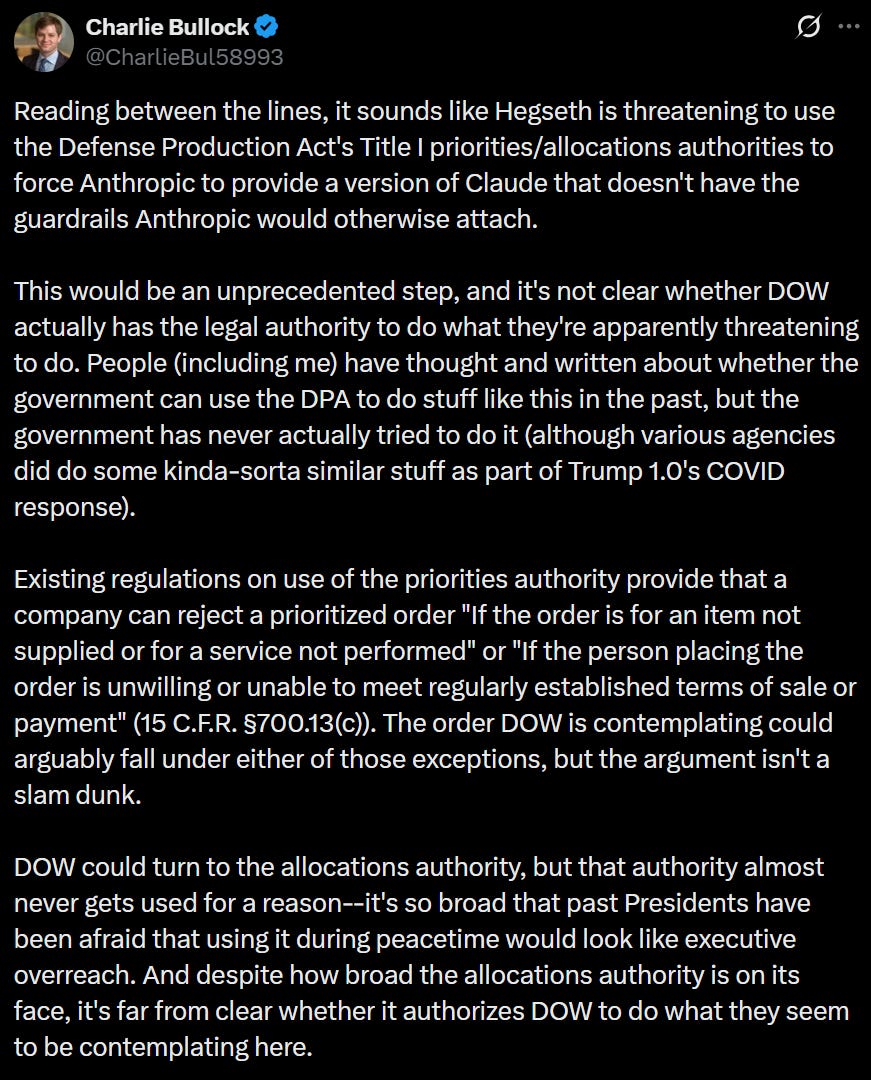
After reports that Claude was used during the operation in which Venezuelan President Nicolás Maduro was captured, Secretary of War Hegseth said that Anthropic has until February 27 to enable the Pentagon to use Claude “without restrictions,” lest face punishment2 from the Department.
Charlie Bullock is a Senior Research Fellow at the Institute for Law & AI, and gives a pretty decent overview:
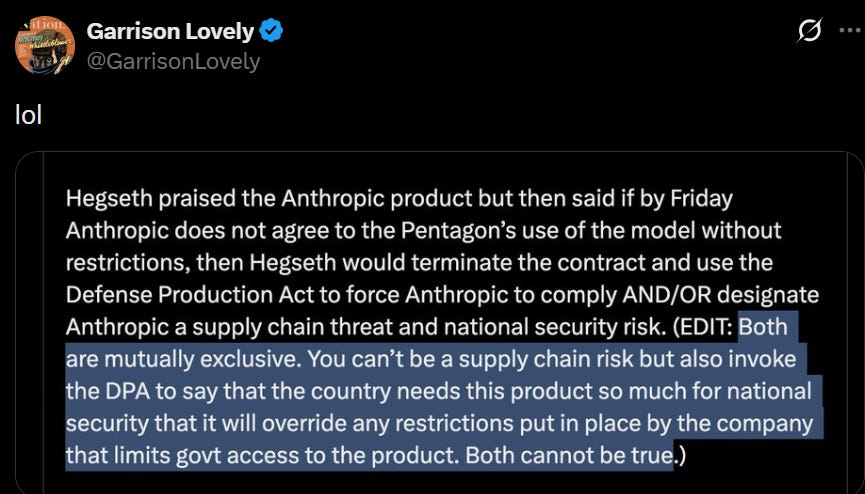
The other threat levied at Anthropic is to designate it a supply chain threat/national security risk. This is usually reserved for foreign companies who we know are doing sketchy stuff, but it would look something like this:
Imagine Microsoft and Palantir both use Claude to develop some of their products. Were Claude named a “supply chain threat,” then Microsoft and Palantir, both of whom do business with the Pentagon, would either need to stop using Claude across all their systems or stop working with the Pentagon (hint: they’ll stop using Claude).
I present this without comment:
As Sam Altman is wont to note, ChatGPT has more free users in Texas than Anthropic does as a whole, primarily because Anthropic has geared its GTM motion more towards enterprise use cases (vs consumer use cases — though they are obviously not mutually exclusive). Such a designation would cripple Anthropic.
Will they fold?3
I don’t know.
But given that Claude is the only model capable of running in classified networks thanks to its IL6 certifications — what Claude itself called, when I was researching why Claude was so important to the military, a “compliance and infrastructure moat” that would take other companies like OpenAI months if not years to replicate — it’s clear the Pentagon needs Anthropic.
Vibe checks
This week, Sam Altman, aforementioned CEO of OpenAI, made waves because he bemoaned the energy it takes to train a human. Or something.
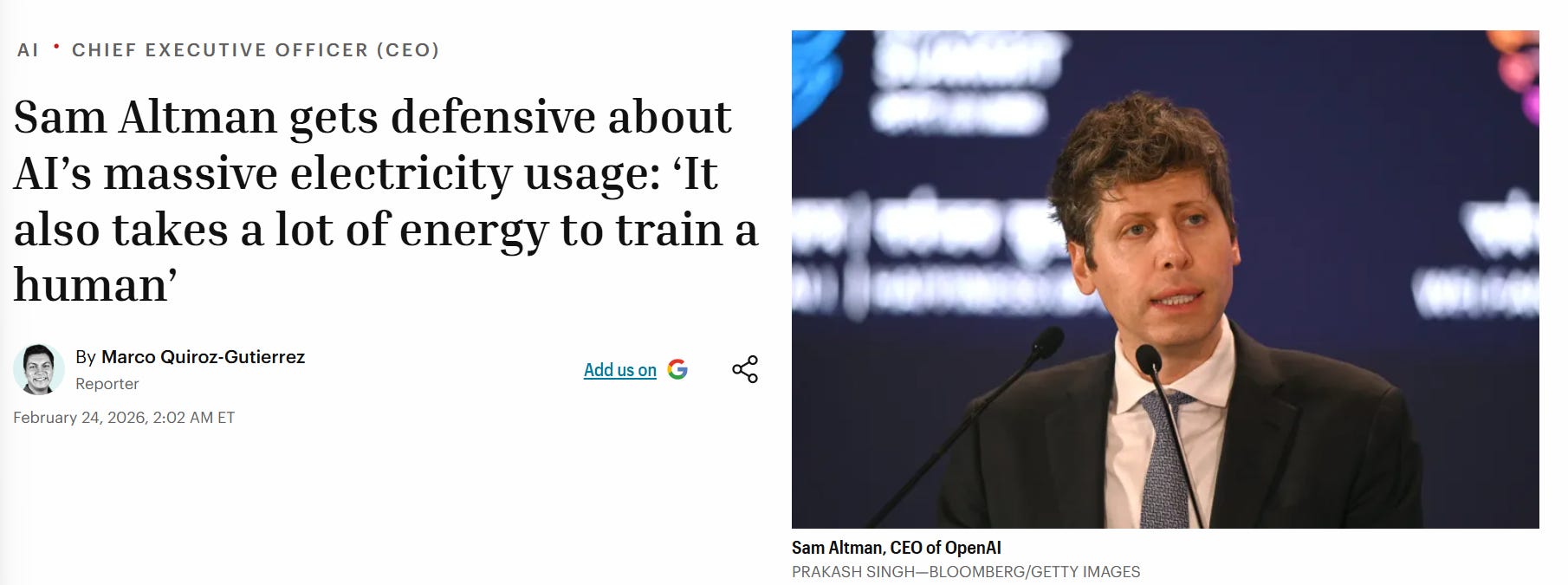
It would take a dedicated 1,000+ word essay to unpack all the things wrong with that sentiment — both from a pure media training perspective and from a, I don’t know, ground-truth humanist perspective? — so I am not going to do that here.4
I will only say that for my purposes and the work I do, I pick my AI model based on vibes. I am not technical enough to parse the differences between Codex (OpenAI’s coding agent) and Claude Code, for example.
Sam Altman continuously gives me bad vibes.5 I don’t use ChatGPT anymore.
Claude gives me good vibes.6 I am a paying Claude user. It enables me to be a better consultant — four years ago I could not have built two website pages for a startup.
This week, I did.
I anxiously await Friday. I want to see if Anthropic bends to Pentagon demands or maintains its safety-related guardrails. We can (and should) have AI-powered drone swarms. We need autonomous technologies on the battlefield to win the next war. And I want us to win, not China. This writer is a USA-number-one kind of guy. But I do not think we should cede all decision-making authority about the use of kinetics to machines. I actually think that is a very, very, very bad idea.
But mostly, I want to see if anyone building foundation models — technology with the power to upend society like no technology since the advent of the internet — will take a principled stand for what they have said they believe in. Leaders who maintain their convictions when it’s easy and when it’s hard are all too uncommon. I’d rather deal with someone I disagree with who chooses to stand firm than someone who changes what they think based on what direction the wind is blowing.
I am fortunate to work with principled tech leaders who have red lines and values, who choose to stick to those values. However, I fear they are the minority. I fear people who have tremendous power can be moved away from what they believe in and forsake their principles to accrue more power.
I’m curious which camp Dario falls into.
I’m curious if Claude will, after Friday, still give good vibes.
If you know me, you know that I do want things just so.
A public whipping? Branding? Burn them like witches? Alas, no.
Here is Dario Amodei, Anthropic CEO, talking about Claude being used in a military context and AI’s relationship when making decisions about kinetic action to the Constitution. It’s worth your time.
Future article idea just dropped?
Don’t take my word for it. Read the New York Times op-ed from a former OpenAI staffer: OpenAI Is Making the Mistakes Facebook Made. I Quit.
This is not a commentary on the merits of AI vis a vis Aristotelian “good.” I have to use AI to maintain a competitive edge, so I do.