

Are memes in politics the downfall of the U.S.?
And other musings about how we communicate online

Note: There were some typos in the emailed version of this essay. Shit happens when things are written by a person and not AI!
Over the past few months, I’ve written about what our online communication habits are costing us, often in unseen, underappreciated, and acutely dangerous ways. I made the case that we should ban TikTok for geopolitical reasons, and dove deep into how short form video is destroying attention spans. I even went as far as to propose long-form journalism as an antidote, because for an alarming number of people, full-length books contain, somehow, depressingly, too many words to manage.
As a keen observer of politics, I’ve also been thinking about how our primary yet dubious methodologies for consumption of information via the internet — short form video and short form text — have impacted the American experiment and our collective psyche.
As I noodled on this topic and began to approach this essay, I thought, essentially, politics-by-short-form-text was the original sin; that we’re being governed by 240 character-length blurbs whose hyper-condensed nature is functionally mismatched with the breadth and complexity of public policy challenges is eroding our collective ability to grapple with those issues.
But amidst (another) war in the Middle East, collapsing geopolitical alliances, a weakening dollar, rampant government shutdowns over immigration enforcement, rising costs of higher education and housing, I realized the situation is far more dire. Our mode of communicating about politics has degraded further, to something more base than ultra-short-form text: Memes.
Memes: A brief history and a radical present
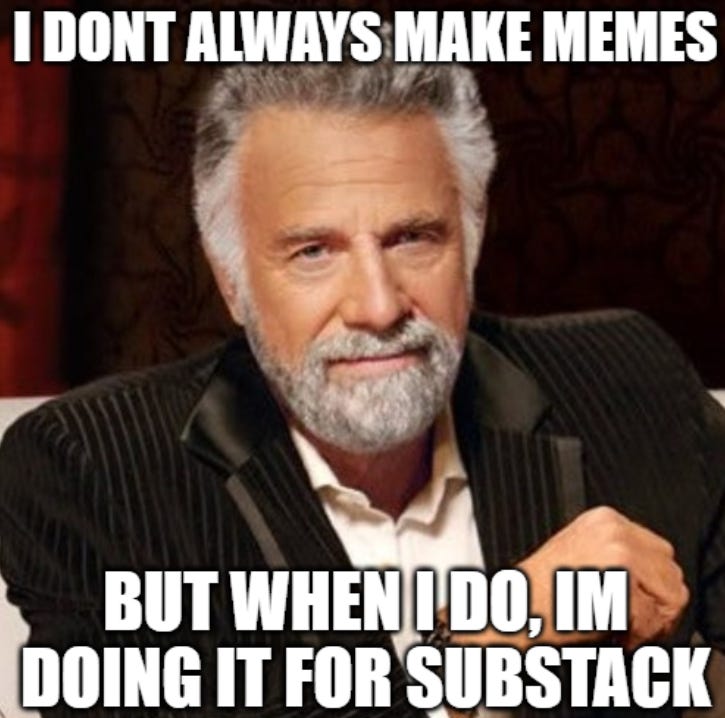
A meme is an image, video, piece of text, or gif that is copied and spread rapidly by internet users, often with slight variations, intended to be humorous and referential. Back in my day, just after Y2K, we had a small-ish subset of defined memes1 with defined meanings. We had All Your Base Are Belong to Us and Numa Numa guy. And then the Dos Equis guy, for example, rose to prominence in the second generation of memes.
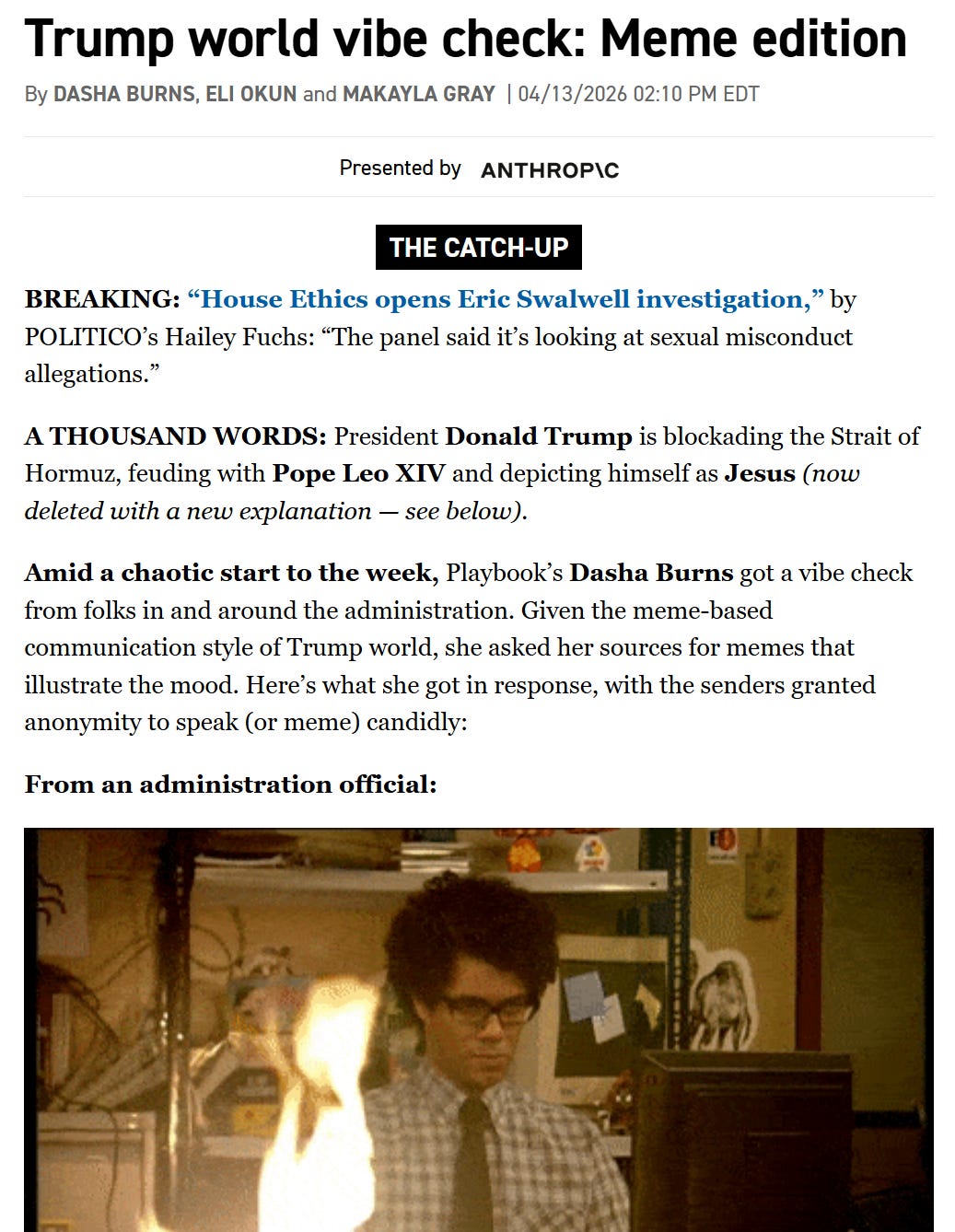
Nowadays, everything is memed — and it’s memed in near real-time. As a member of the terminally online community, I am embarrassingly up to speed on the latest memes. I am a guilty participant, sharing memes with friends about the New York Giants’ draft freak Arvelle Reece and really serious stuff, like the Trump vs Pope argument (that particular internet spat resulted in Trump posting-then-deleting an AI-generated meme of him as Jesus2).
But I’m just a regular guy that likes to laugh at funny stuff on the internet. The problem is that some of the largest and most prominent institutions on Earth also have begun to communicate via memes, and that’s — and hear me when I say this — actively destructive, especially in politics.
To wit, three examples.
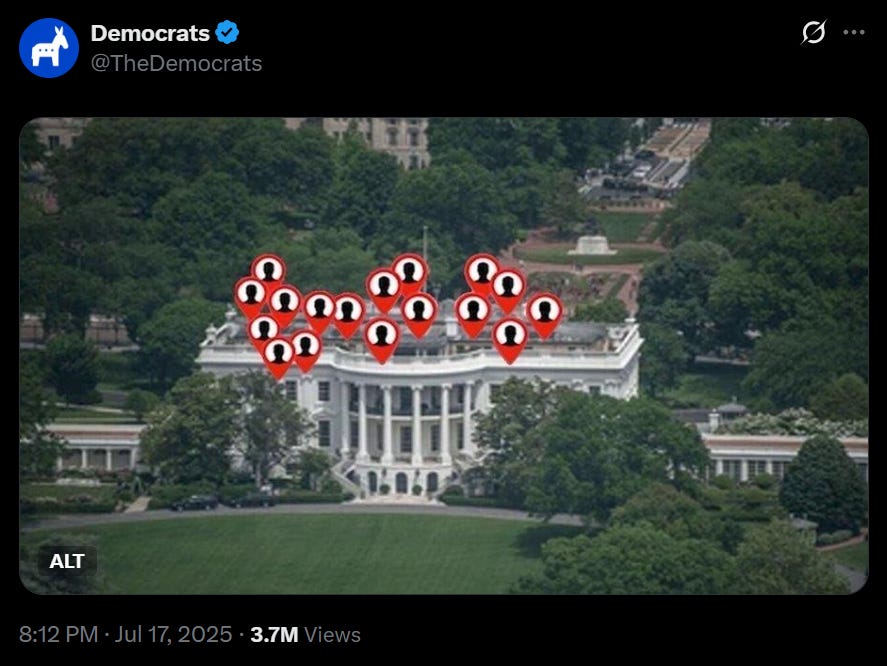
One: The House Democrats sharing a Kendrick Lamar meme about the White House implying President Trump is a pedophile (a play on Lamar’s diss track implying the same claim about Drake).
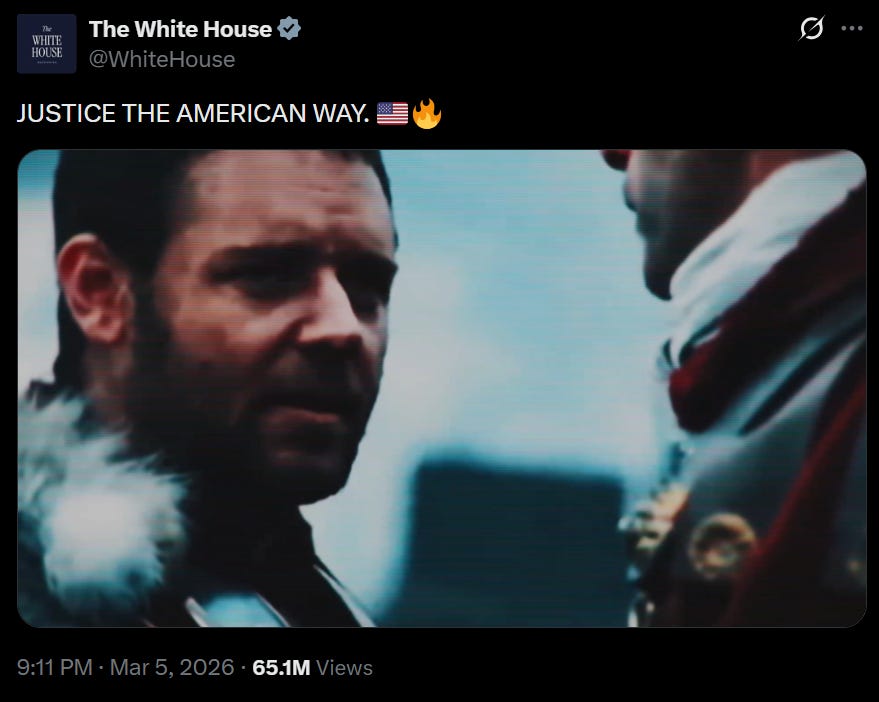
Two: The White House, in the middle of war, making memes — which are meant to be humorous — about dropping bombs on another country.
A recent Politico Playbook headline was literally Trump world vibe check: Meme edition
Three: The Iranian Embassy posting an AI-generated meme video of Trump, mocking his handling of the Strait of Hormuz.
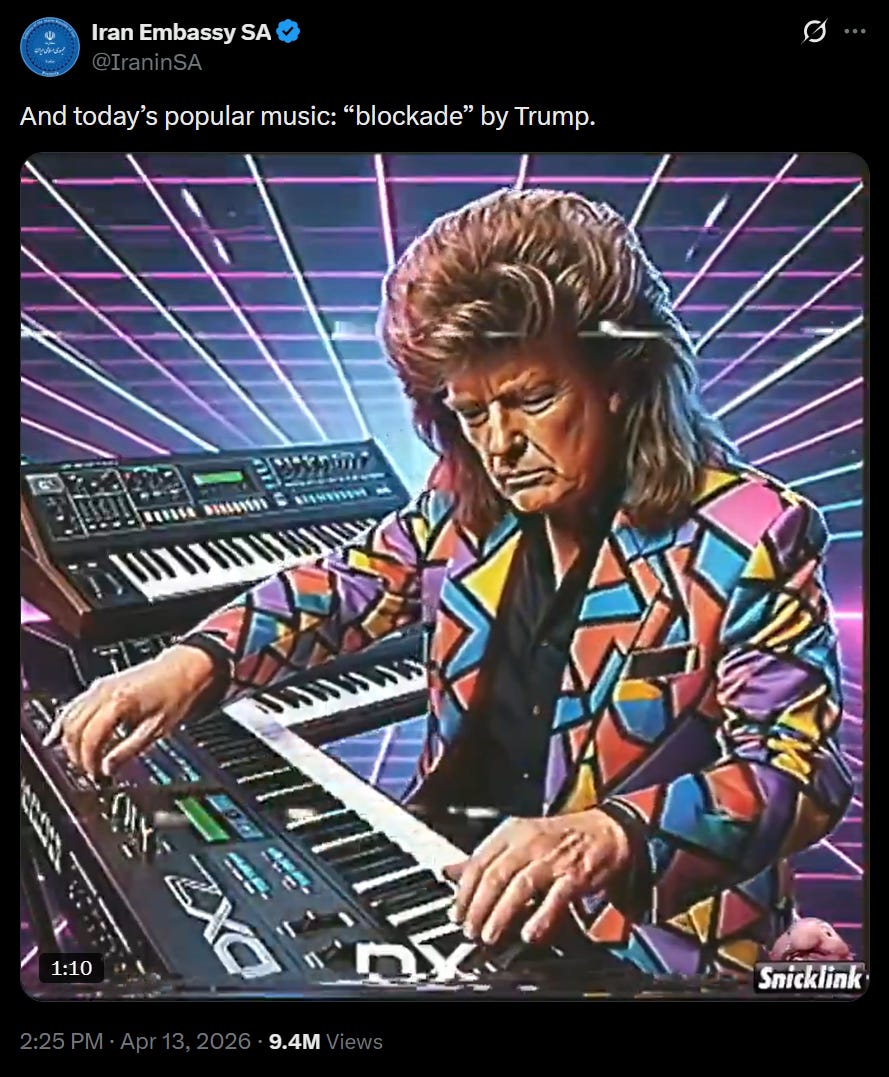
I would like to pause here for a moment to let the absurdity of the above sink in.
Still with me?
Both Republicans, Democrats, and America’s hostile adversaries are joking online about war, the death of civilians and soldiers, and having sex with children.
Again, it bears repeating that I share memes about all sorts of inane topics. I understand the predilection to joke about the horrors, and I love when comedians use humor as a path for social commentary. Sometimes, the only way to avoid crying is to laugh.
But again, I’m just a guy. They’re just comedians. Their job is to make us laugh, not to decide whether or not to put soldiers in harm’s way, or whether or not we can have paid parental leave, or how many tax dollars we allocate to help people experiencing homelessness get back on their feet, or how much housing we build, or the myriad other very real responsibilities of federal, state, and local government institutions..
There are, sadly, nigh infinite examples of prominent public figures in politics and business from across the range of the political spectrum who now rely on memes as a central plank of their non-video-based communication strategies. When I worked in politics in the early 2010s, a politician posting a meme was risky, aberrant behavior — certainly not the communication style du jour
I’m not trying to be some stodgy old man yelling at clouds. I just don’t think we should have serious debates about the most fundamental, will-the-next-generation-live-better-than-the-generation-before, is-the-American-dream-still-alive type issues confronting our society via meme.
Policymakers need to propose solutions to societal problems, not make jokes.
But how did we get here? And can we return to the days where taking serious issues seriously mattered more than ratio’ing someone on Twitter?
All algorithms, all the time
Modernity is defined by, if nothing else, algorithmic curation. These days, there is so much more content to watch or read or buy. To commoditize this glut of stuff, companies use machine learning algorithms and artificial intelligence to recommend things specific to each user.
I wrote about this extensively in a previous essay, but here’s the pertinent bit:
Every major social media platform “recommends” content with posts from people you choose to follow. TikTok does it well; Twitter, not so much. Netflix has recommended shows that I never knew existed, then watched and loved (RIP Teenage Bounty Hunters).
When I buy an air purifier on Amazon, Amazon recommends that I buy five more air purifiers, for reasons that remain unclear. Hell, odds are that if you’re reading this, algorithmic recommendation engines played a role in surfacing this content to you.
If you think this is limited to our interactions online — “I can escape The Algorithm if I go outside” — you’d be wrong. Grocery stores maximize revenue by using AI to optimize what products go where and on what shelves.
Because these algorithms prioritize short-form everything to match our limited attention spans, then of course memes have become a popular way to get eyeballs on a post.
Which is cool when we’re talking about probiotic soda or shoes or whatever. It’s less cool when we’re, you know, talking about policies that dictate the direction of the United States and democracies around the world.
Every viral meme posted by a politician doesn’t capture the nuance of public policy — it adds to the pile of slop on the internet.
The death of expertise
Since the beginning of the COVID pandemic, distrust in scientists has grown by 15% points.3 Also, I’m loath to relitigate the role of experts throughout COVID.
The main takeaway? The idea of expertise has taken a hit. “I’ve done my own research,” feels like a defining phrase of modern times.
What does this have to do with memes, exactly?
My pet theory goes something like this: Trust in institutions and the experts who populate them across science, academia, politics, and business is down. Today, the general public is more willing to listen to people with whom we already agree with or are entertained by, than willing to be challenged by facts4. As a result, shitposting memes, something inherently incongruous with deep examination of real issues, has evolved into a common form of communication, because the people posting them oftentimes do not have demonstrable expertise, and therefore forms more appropriate forms of communication — long form writing, a nuanced discussion — are inaccessible to them.
Memes are the only thing that’s left.
And make no mistake — as far as disseminating a message goes, memes work (see the memes above, which each have millions of views, likes, and reshares).
But in the realm of public policy, memes are destroying our ability as a collective to meaningfully grapple with the most important issues confronting our society.
(Hint: That’s bad.)
Give Congress a pay raise
About 200-ish years ago, Joseph de Maistre, Lawyer and former Kingdom of Sardinia Minister Plenipotentiary to the Russian Empire5 wrote that “every country has the government it deserves.”
The pessimistic side of me wholeheartedly believes this. Most members of Congress are not the creme de la creme that you’d want making decisions (see: The death of expertise).
In the 119th Congress, the average age is 58 years old. There are 50 senators over the age of 65. I refuse to believe that this demographic, full of people racing towards retirement and social security, are ready to grapple with the economic implications of AI or manage the rising cost of housing and higher education or the geopolitical realities of the Indo-Pacific.
It’s farcical, at best. When was the last time you met a 70 year old in the wild and thought, “yeah, this person should be in charge of everything.”6
But the incentives do not exist to get our best and brightest into public service. Members of Congress are paid $174k a year. It’s not dirt — that’s a good salary! — but if you want to earn more than that, you’re better off being a pilot. Or a dentist. Or a doctor. Or a lawyer. Or an architect. Or a financial manager.
Private companies learned a long time ago that compensation and benefits attract talent (there’s a reason why Meta is paying top AI execs a billion dollars each in total comp7). If we want to attract serious policymakers who will communicate with the general public about serious issues in a serious manner, one thing we can do is give ‘em a raise.
Hopefully that will breed some competition, at least. And ideally some people who can communicate in complete, coherent sentences without their remarks written down.
How do we reverse policy-by-meme?
The answer to that question is, quite simply, I don’t know.
I’ve been remiss in writing essays because the shit-post-ification of U.S. policy has been rattling around my brain like a ping pong ball for, quite literally, months. And then I came upon this tweet8:
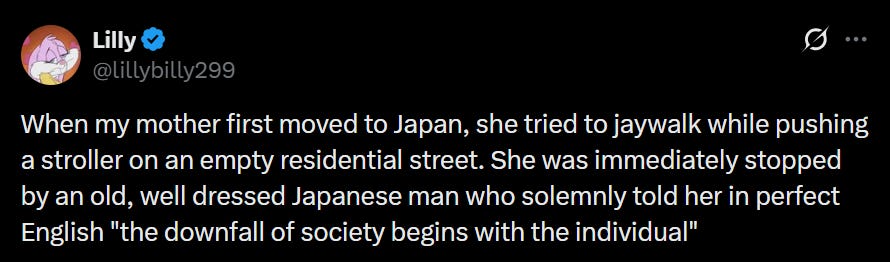
“The downfall of society begins with the individual.”
It sure does.
So while I do not have any societally proscriptive recommendations, I can start with myself. I can give dense topics, like the war with Iran or AI’s potential white collar job apocalypse or the housing shortage, the due diligence they deserve. I can read. I can digest a myriad of opinions about solutions to these topics which I can use to formulate my own. In other words, I can, myself, try to be a reasonably informed observer about the world. And that means, when there is something I care about, I am going to engage with it — not just meme about it.
If the downfall of society begins with the individual, then so too can a society’s resurgence begin with each and every one of us.
Shoutout to Emily Ann Hill for providing feedback and editing this essay. Check out Junetail Creative to see how Emily can help improve your writing and, for small businesses, develop an unforgettable brand experience.
Yes. This is the wildest timeline.
My favorite example of this recently is March Andreesen, who is, by all accounts, a smart guy, firmly saying that introspection is a modern invention. Which, if you’ve read any philosophical texts produced in the last couple of thousand years, you’ll know is an obviously and completely insane thing to say.
My God, what a sick job title.
This is not to say I am ageist. There are many people in their 70s that I love — hi mom, hi dad! — and there are many members of Congress who, despite their advanced age, remained serious operators (see: Nancy Pelosi). But we’ve got to play the odds and understand that older generations nearing retirement have a fundamentally different set of concerns that are often in conflict with all younger demographics.
Unrelated, but I recently spent some time in Japan. I’ll have some Japanese-centric posts coming soon.