


One of the most meaningful gifts I’ve ever received is a calligraph of the Dalai Lama’s Instructions for the New Millennium, given to me from my father. It’s an expression of my dad’s desire for me to live a good life and be a good man. It holds thousands of unspoken words over decades, hundreds of small lessons from father to son, and a life’s worth of emotions captured in a single picture frame.
I look at it, hung on my wall, every single day.
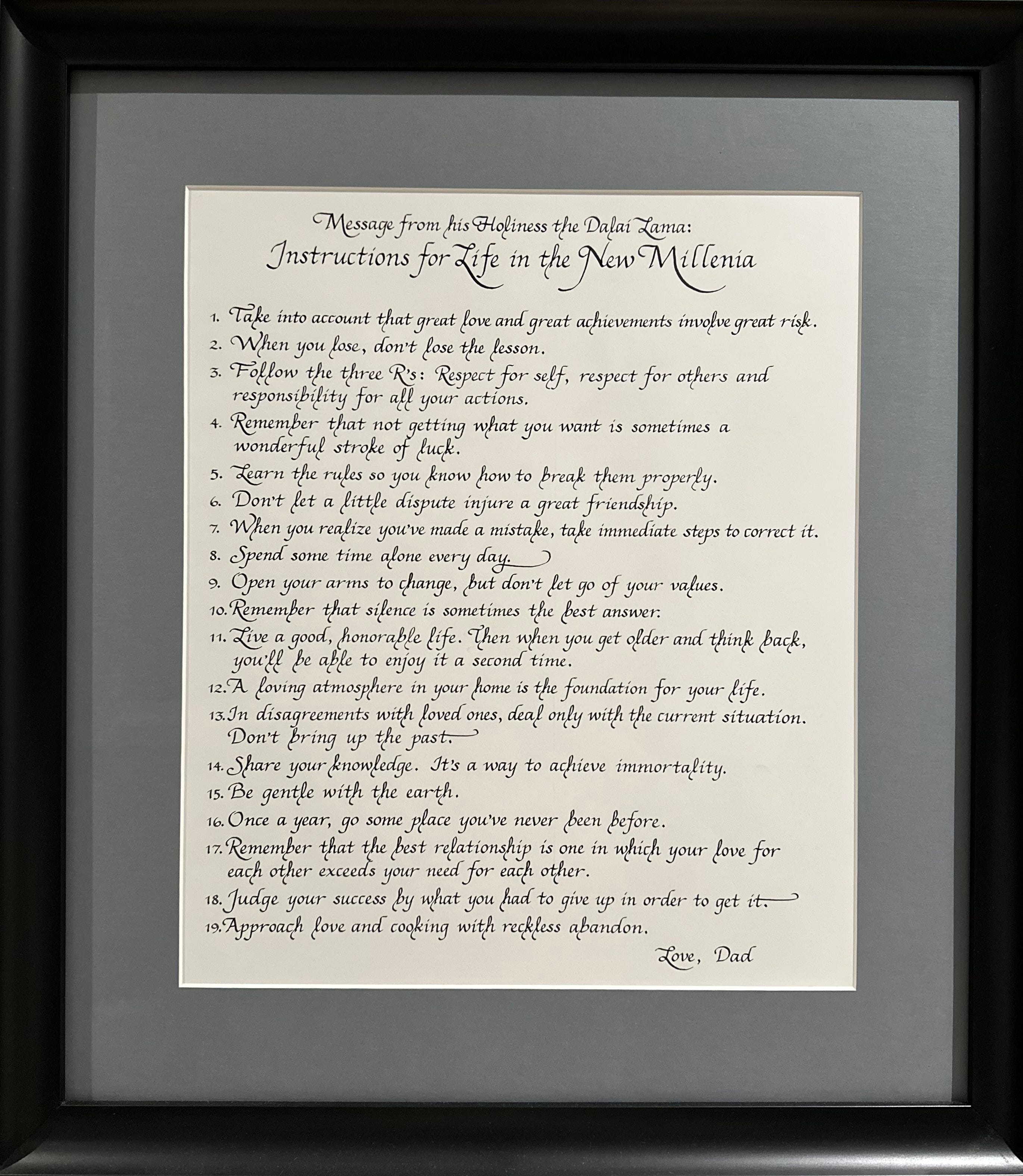
Recently, I discovered that these instructions weren’t actually written by the Dalai Lama, though that makes the lessons contained no less meaningful and the gift no less important.
The Dalai Lama calligraphy taught me, from a young age, that wisdom can come from all sorts of places.
So when I arrived on Capitol Hill in 2011 as a wide-eyed, idealistic intern with no political connections and little experience, learning from people smarter than me was priority number one. Despite my best efforts, almost no one gave me the time of day — politics is aggressively transactional, and as an intern, I had absolutely nothing to offer, which meant senior staffers (or any staffers, for that matter) had no real reason to help me. Fortunately, a few Chiefs of Staff offered to squeeze me in, finding time between their meetings with lobbyists, fundraising, and charting their bosses political and legislative futures to help me out.
And help they did.
Nestled between varying perspectives on how to become an effective politico, every single Chief told me, without exception, to “pass it on.” That, one day, I should do for others what they did for me, and share what I know with no expectation of reward. At the time, I was so out of my professional depth, the idea of teaching others felt like retirement: Far enough away to not be a practical concern.
Today, their advice feels like sage wisdom from His Holiness himself.
Earlier this year during an informational interview, I did, in fact, have the opportunity to be giving advice for a change (much to my chagrin, I am getting older). It was in that moment that I realized, in spite of the very real imposter syndrome and cognitive dissonance I was facing, I have learned a lot during my career.
I’m definitely no Dalai Lama, but I still want to share wisdom I’ve accrued from other people with you.
Communications Instructions for the New Millennium
1️⃣ Know what you don’t know
In Plato’s Apology, he wrote “For I was conscious that I knew practically nothing.” Be mindful of knowing what you don’t know. There are always people smarter than you — in your own discipline, and outside of it — who can teach you something. Challenge your own assumptions and test them. I realize the irony of starting a list of instructions with the fact that we know nothing, but here we are. I hope that with new knowledge, I’ll be humble enough to change my mind when I should.
2️⃣ If everything is important, nothing is
Working in communications means putting out a lot of fires. There’s always something someone needs you to do, a billion incoming requests across lines of business, urgent this, urgent that. But at some point, you have to prioritize. If everything is of equal importance, then definitionally, nothing is.
Choose. Choose how to allocate your time. Choose what not to do. I, like many communications pros, struggle with the trap of urgency, failing to raise my gaze beyond the most immediate concern. When I feel myself sucked into a vortex of urgency, I try to remember the words of fictional hedge fund manager Bobby Axelrod from the show Billions: “The greats never sacrifice the important for the urgent.”
3️⃣ The best way to start is to start
I love this meme:
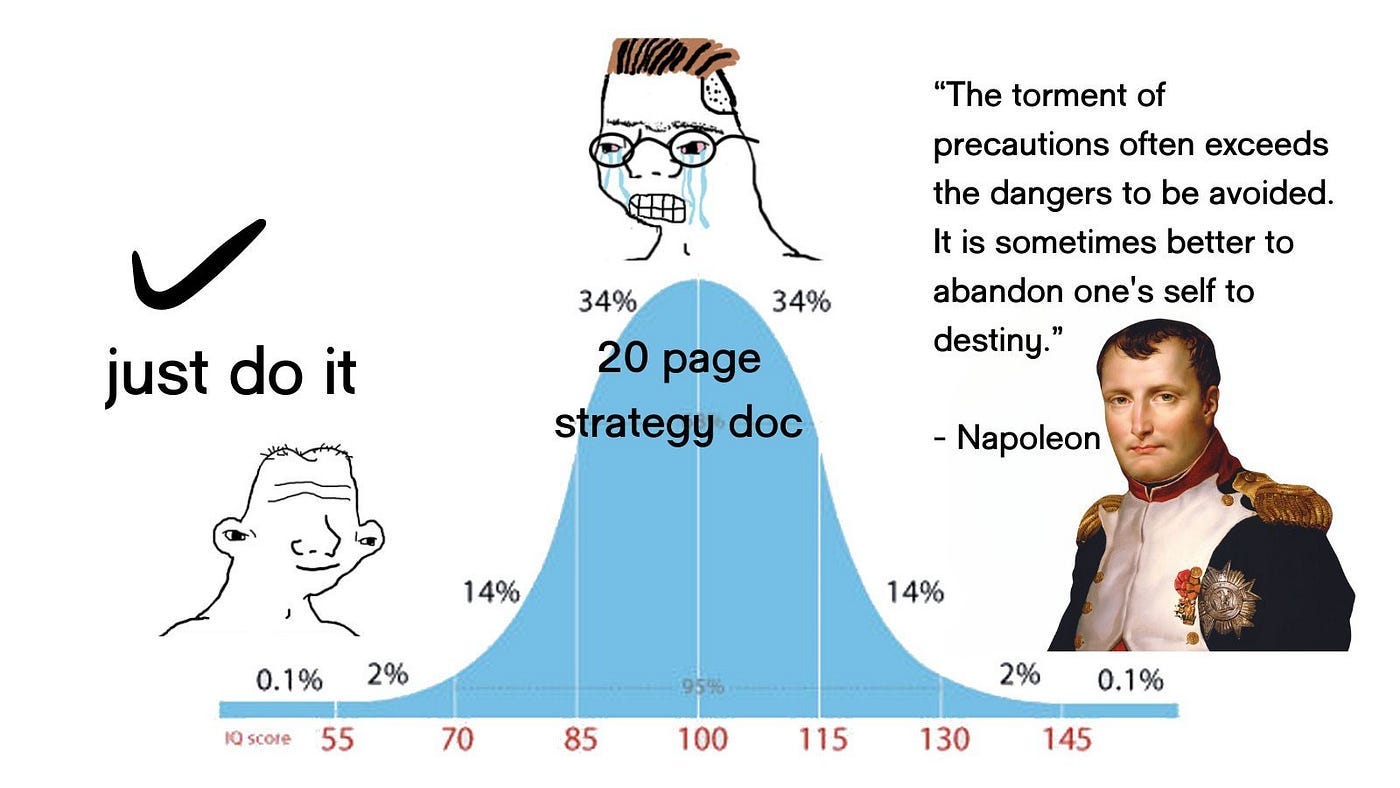
I am not suggesting abandoning strategy entirely. I love a good strategy doc (as long as it’s not a deck). But too often, I see people afraid to do anything until the strategy is fully fleshed out and all questions are answered. You will never answer all questions before you start something. Unknown unknowns are real.
You must simply Do The Thing. Start the project, start the essay, start the strategy. Just go. There is intrinsic value in progress; you’ll either succeed or identify what you’re doing wrong. And that leads us to number four:
4️⃣ Inaction is action
Doing nothing — stasis — is perceived as safe because inaction means you won’t do anything wrong. But there is an opportunity cost to standing still, and in my experience, it’s far worse to do nothing than to do the wrong thing. If you walk in the wrong direction, who cares? Mistakes are part of life, and communications is no different. Errors are one of the few certainties of human existence. Embrace the opportunity to learn that comes from mistakes (you get a lot of good data by trying to do something, rather than standing still), fix them, and restart again in the right direction. If you never move, you’ll live in uncertainty.
5️⃣ Take notes
The person who writes down the thing has tremendous power. — Marc Andreessen
At my old PR firm, it was typically the junior staffers (myself included) who were new to tech PR who were responsible for taking notes on client calls. It was seen as drudgery — the more senior people needed the brain space to conduct the conversation, which meant passing off note-taking to someone below them.
I’m really good at taking notes now, and I didn’t appreciate how important that skill was until recently.
In fact, Dave Perell, notorious writing GOAT, recently interviewed a16z’s eponym Marc Andreessen, during which Andreessen touted the importance of note-taking. The “tremendous power” Andreessen refers to is being the arbiter of Truth. In absence of an actual recording , the owner of the notes knows who said what and who is going to do what.
Embrace the power. Take notes. Deliver Truth.
Communications across organizations — startups, non-profits, large corporations, PR firms — is a blend of art and science. As practitioners, we need to be willing to share advice and principles with one another to learn together. So, if you’ve got some sage wisdom, drop it below for all to see 👇
Shoutout to Emily Ann Hill for providing feedback and editing this essay. Check out Junetail Creative to see how Emily can help improve your writing and, for small businesses, develop an unforgettable brand experience.