


Google owns a massive share of the Search market — around 89%. But late 2024 marked the first time in a decade that their market share dipped below 90%. Worse, on desktop — you know, those devices on which most white collar workers do their jobs — the number recently dropped to just 79.1%, which is reportedly an all time low.
I expect this decline to continue because frankly, Google search kind of sucks now. The implementation of AI into their search results went poorly, to say the least.

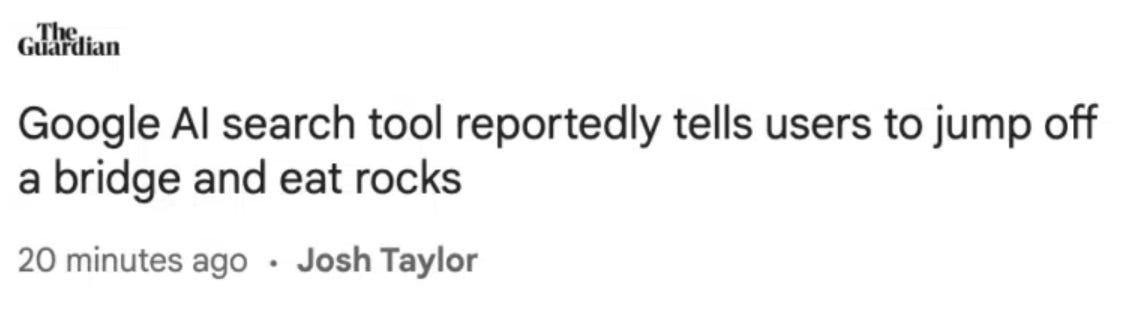

I gotta tell you, I am not going to eat rocks or put glue on my pizza, and I’ve never seen a dog in the NBA (though I did love Air Bud). In the immortal words of legendary detective Benoit Blanc, it’s just dumb.
Beyond unreliable, insane, and downright stupid research results being served, a similarly large problem has emerged: If a business relies on search to find customers, those days are over now, writes CJ Gustafson1:
The unwritten agreement we’ve had for the last 20 or so years was that if you wrote stuff that others found valuable, Google would crawl, reference, and serve back your site for people to visit. In fact, Google’s founding mission was to get people out of Google and to what they were looking for as fast as possible.
The reality now seems to be if you do the hard work to write something people find valuable, Google will crawl, reference, and serve them your info in a synthesized version, outside of your website, skipping the trip to your domain all together.
Wall Street is still bullish on Google’s search, however. Bank of America analysts wrote: “We continue to believe Google has data and distribution advantages and has closed the (large language model) performance gap.”
I’m less confident. Perhaps I’ve lost a bit of consumer trust as a result of Google telling me to eat rocks, or perhaps functionally losing all utility for businesses is a bad recipe for continued success. It may take a while for this giant to die, but die it will.
So what’s Google to do?
Congratulations Google, you're a car company now!
Recently, I spent a week in the Bay Area. It was the first time I took multiple Waymo rides — the Google-owned self-driving car company — over a sustained period of time, and I have to say, it’s amazing. Waymo delivers a genuinely sublime, futuristic experience in which I felt safer, had a better commute, and saved money. It’s hard not to feel awe struck by something that, even a decade ago, would have been seen as sci-fi levels of fancy, far removed from real life.
When I sent the video above to my group chat with my best friends, here’s what they said:
“Do you feel safe?”
“That’s a wild video”
“Damn man, you’re braver than I am!”
“So what happens if it just locks the doors and takes you to Mississippi?”
Like the death of Google Search, adoption of self-driving cars will be slow — but it’s going to happen. The technology, the consumer experience, the cost is just too good. It’s so damn cool. I’m convinced that in 10, 15 years, driving oneself will be a luxury.
Let’s break it down:
The average commute in the U.S. is 12 miles each day for an average of 21 work days a month, so let’s say the average person drives 250 miles a month to work. Owning a car costs about $1,000 a month, and it’s only getting more expensive. If Waymo gets its cost down to under $4 per mile, which is absolutely possible given the deflationary aspects of its business model (no gas, no people), it would be cheaper to Waymo every day to and from work than to own a car.
Does that scale even make sense for Google? The answer is a resounding yes.
Despite Google Search’s abject failings and decline in market share, the company’s 2024 revenue was $348.16 billion, an all time high. That’s a ton of cash.
But, but but: Even just 25% of the personal car market would amount to ~$380 billion to $400 billion. If it’s cheaper and more effective for one out of every four people to take a Waymo instead of owning a car, Google will make more money than they quite literally ever have with all their other services combined.
As I anxiously await Waymo’s expected arrival in Washington DC in 2026, I’ll be the first to admit that mass adoption of self-driving cars in the next few years won’t happen immediately. Lots of people will be nervous, and anything so radically outside the norm requires time before mass adoption.
But hey, 10 years ago, the idea of self-driving cars seemed insane. If you told someone in the year 2001 that 24 years in the future we’d all be walking around with tiny, hyper advanced computers in our pocket that could quite literally connect nearly every human and digital experience on earth, they’d have you committed. Maybe I’m showing my age here, but I remember teachers telling me I wouldn’t have a calculator with me all the time (and now we have artificial intelligence in our pockets).
Picture a world where the nearly 500,000 car crashes in the U.S. a month are functionally reduced to 0. Think about every woman who will feel safe taking a ride home from the bar because there’s no driver knowing where they live or the long trips we’ll be able to take by car because we can nap while the car drives. Imagine everyone having the opportunity to read a (physical) book during a commute — a luxury only those in cities with robust public transportation can currently enjoy. Just think: No more haggling with mechanics, worrying about this certification or that license or whether or not your apartment building has parking.
Given that world, would you really be shocked if, in 10 more years, more of us are bopping around in Waymo’s than not?
I wouldn’t.
Shoutout to Emily Ann Hill for providing feedback and editing this essay. Check out Junetail Creative to see how Emily can help improve your writing and, for small businesses, develop an unforgettable brand experience.