


As a communications consultant, the people and companies I work with ebb and flow. I’ve done quick projects with companies, tantamount only to weeks. I’ve also been fortunate to work with some startups for years, forging deep partnerships. I’ve worked with startups across industries, too: autonomous vehicles and aircraft, clean energy and EV infrastructure, cybersecurity, space and geospatial data, cybersecurity, biotech, AI and ML platforms, data science infrastructure, and a whole host of SaaS companies.
But at some point, every relationship was new. I didn’t know the industry (there’s a first time for everything!) and I didn’t know the personalities of the team I was working with. And invariably, I received effusive praise for work that I felt was, generally (and to quote Don Draper), “what the money was for.” I didn’t view it as exceptionally above-and-beyond.
I’m reluctant to attribute such praise to my own exceptional ability. I do believe I’m quite good at my job but I’m not arrogant enough to describe myself as a wunderkind. I also think it’s fair to say that I’m better at my job than most.
Comms is a crowded industry: For each reporter, there are six or seven comms flacks1. Standing out among the crowd isn’t easy. And while I firmly believe one should always strive for peerlessness, being what I call “radically competent” is the key to long-term success.
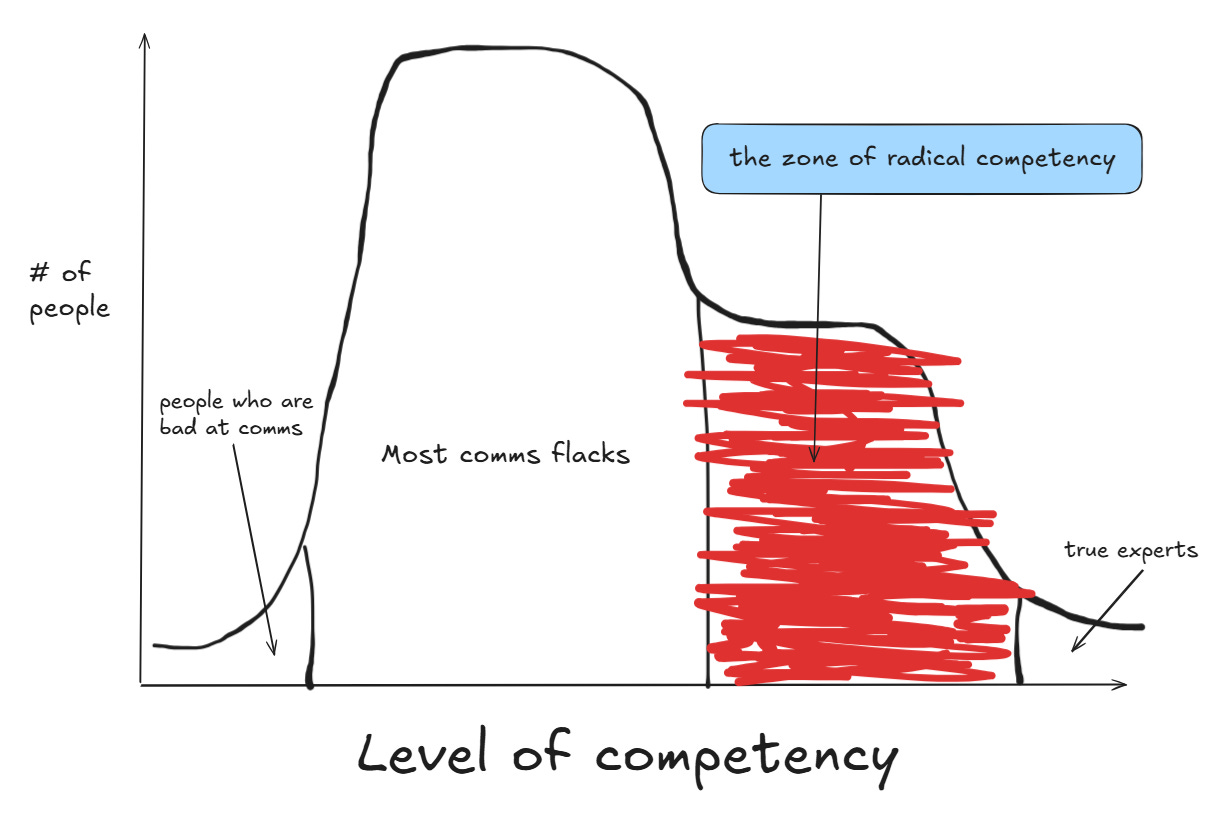
The concept of work in the Zone of Radical Competency is abstract; it represents work well done, which will vary depending on the job to do. The path to radical competency is anything but abstract (I’ll show you how to get there). And if your work consistently hits the Zone of Radical Competency, you’ll far exceed the vast majority of your peers.
Be proactive
You’d be shocked at how many comms or marketing people wait for direction from a superior to do things. Sometimes, comms flacks are unwilling to propose big strategic swings (like a massive investment in video) unless their boss tells them: “Propose three big ideas.” I’ve heard horror stories of comms flacks and PR agencies not building media lists for an upcoming news moment until prompted.
At the risk of strawmanning, they’ll sometimes use organizational strictures — “I have to get approval!” — as a reason to avoid proactivity.
Reminder: You can just do things.
And even if you really, truly, actually do not have the operational or tactical freedom to do things, you can still have ideas. You can share those ideas. You can aggressively advocate for those ideas to be executed. You can pair ideas with a path towards execution to demonstrate idea viability.
Being proactive can manifest itself tactically — little things like suggesting a Reddit AMA or training an up-and-coming executive to be a spokesperson can move the needle. Likewise, stepping back and raising your gaze, assessing the marketing/comms operation (even just your slice of it) from a strategic view and proposing a solution to solve problems can also create value.
Don’t let the work happen to you. Get in the driver’s seat. If you do, you’ll almost certainly hit the Zone of Radical Competency.
Ask questions
There are absolutely such things as dumb questions. But it’s imperative to be unafraid to ask them.
In my own world, where I spend time with a lot of engineers and technical leaders and CTOs, I ask a boatload of dumb questions. I’m no expert in the technical differences between RL and traditional deep learning techniques (I don’t have a PhD), and I’d rather hear about it from a CTO. Could I ask Claude? Absolutely. But the value of kicking the tires with a true, human expert affords understanding and perspective.
The knowledge I gain from asking dumb questions to smart people does four things:
I learn complicated topics quickly
I gain conversational fluency across technical domains
I obtain specific insights into technicalities that I wouldn’t otherwise know
I understand why someone thinks what they think about a technical topic
Curiosity is, in and of itself, a sign of a radically competent person. And knowledge empowers me to be more proactive, which is important2 to hit the Zone of Radical Competency.
Fight back
Radically competent people fight back. Most high-agency founders do not want a “yes person,” they want real counsel. This isn’t always true. Once upon a time, during a kickoff meeting with a client in my PR firm days, I pushed back on something only to be promptly fired on day one by that client3. However, in most of my experiences, healthy disagreement leads to healthy relationships.
So if you disagree with something, speak up. Have salient rationale. Stand by your opinion. Speak simply and directly and explain why you believe what you do. Even if the initiative is not strictly a comms one, it will likely impact how the brand is perceived. And as I wrote about this time last year, comms people play a key role in how businesses make decisions.
Two critical caveats:
If you learn new information, change your opinion. Don’t be wishy-washy, but don’t be afraid to consider new inputs that might change the output
Once a decision is made at the organizational level, get on board. The founders’ names are on the door. They make the ultimate call
Crush the competition
Excellence is the north star. Reconsider my beautiful graph.
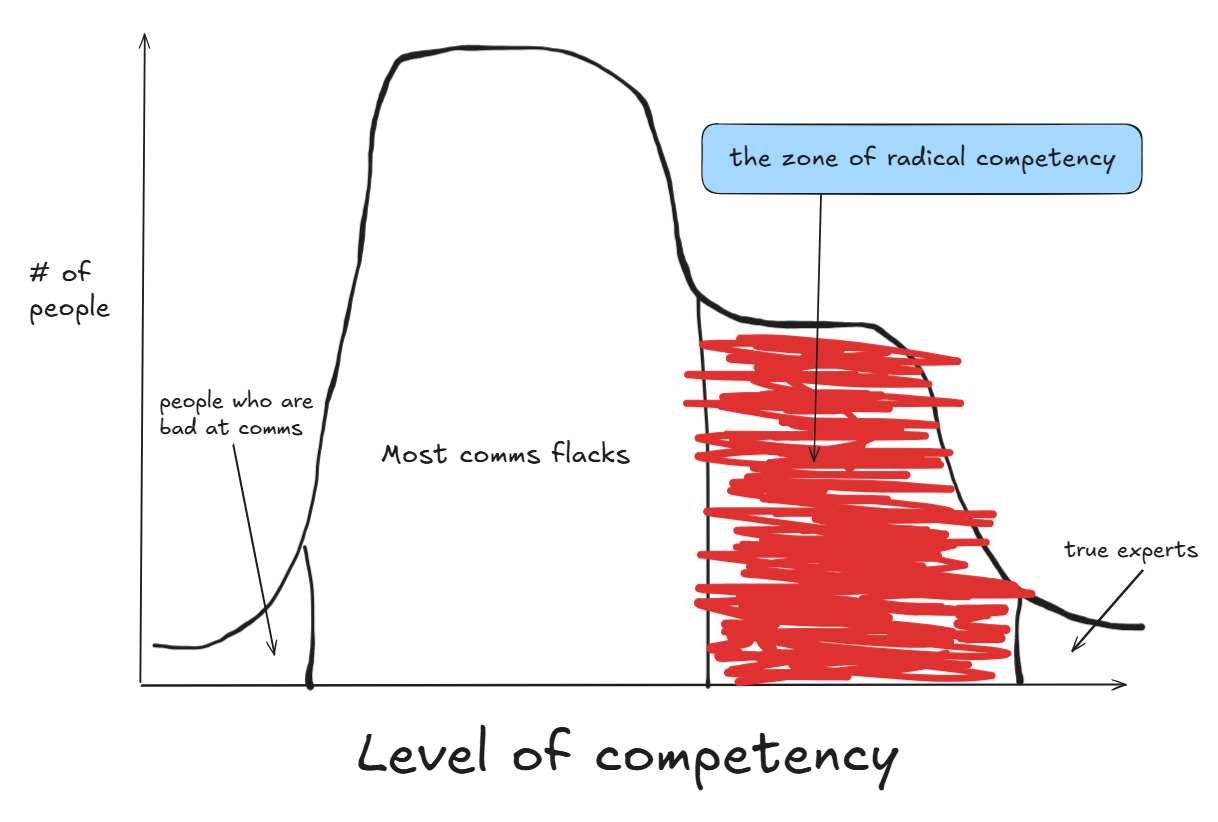
I want to be in the far right zone, that of true experts. We all should want that professionally. Like the great Ron Swanson once said, “Never half-ass two things. Whole-ass one thing.” Meaning, if I’m going to do something, I care about doing the thing well, because I want to be as far right on the x-axis as I can be.
But I also know I’m not going to have demonstrable expertise in everything I do all the time. But if I set that as a goal, I will, at worst, land in the Zone of Radical Competency. It’s a shoot-for-the-moon-land-among-the-stars type thing.
If you pair an effortful mindset with proactivity, a natural curiosity that leads you to ask questions, and a willingness to advocate for the ideas you believe in, you’ll likely be better than the vast majority of your peers.
And make no mistake — that matters. Yes, many PR people and comms flacks are friends and in communities and there’s a lot of work to go around, but the work is not infinite. The size of the pie may grow and change, but it is finite. If you want your slice, you need to stand out.
When so many comms flacks decidedly don’t get shit done, it’s a good reputation to cultivate. The Zone of Radical Competency is the way.
Shoutout to Emily Ann Hill for providing feedback and editing this essay. Check out Junetail Creative to see how Emily can help improve your writing and, for small businesses, develop an unforgettable brand experience.
See above. Be proactive!
Their company ended up failing. Whether or not these things are correlated is a decision for you, dear reader.