


“Hey, just don’t say dumb shit. You know what that entails.” A friend of mine was telling me about a time she was preparing members of her sales team to attend a major conference, drilling them on key talking points and best practices, only to end her missive with what became a simple sentiment that enshrined her in the company’s lore: Don’t say dumb shit.
Communications people are uniquely positioned to help organizations avoid saying and doing dumb stuff because we are trained to think about — and genuinely care about — perception and how company messaging is received. In fact, I wrote my maiden essay about how critical perception is to business success:
How a company, brand, and/or founder is perceived is their reality (reality being revenue, stock price, and/or the ability for a company to sell its products or services).
I try to avoid dunking on people, particularly in the professional realm. Everyone makes mistakes, and while I’m certainly not immune either, it is instructive to look at a few examples of screw ups from some of the largest technology companies on Earth. To make this fun, I picked examples of grievous, unforced errors that were tantamount to doing something dumb with no consideration for how the action/policy/statement would be perceived.
🧠 In November 2024, Microsoft launched Recall, a feature that continuously screenshots users’ computer screens. At launch, the feature was auto opt-in (meaning Recall was automatically turned on for all users). The data didn’t have great safeguards, and there weren’t a ton of protections if there were screenshots that captured passwords, sensitive financial information, or other data that, you know, you wouldn’t want to have a screenshot of. To Microsoft’s credit, they delayed the launch six months and fixed some of the privacy concerns (PC Mag has deets).
💬Slack was mired in controversy in May 2024 when it not only appeared to be using user messages (including DMs!) to train its AI, but because they automatically opted-in all users without notifying them. To make matters worse, opting out appears to be intentionally designed to be an onerous, overly manual, multi-step process to dissuade people from doing so by way of pure, unfiltered frustration (for those of us who’ve had to click 489,572 times to unsubscribe from an email, you know how annoying this is). Here’s the opt-out note from Slack:
Contact us to opt out. If you want to exclude your Customer Data from Slack global models, you can opt out. To opt out, please have your org, workspace owners or primary owner contact our Customer Experience team at feedback@slack.com with your workspace/org URL and the subject line ‘Slack global model opt-out request’. We will process your request and respond once the opt-out has been completed.
It’s as if the person who wrote this wanted users to hate them (comms pro tip: You don’t want your users to hate you).
🚺 In May 2024, OpenAI didn’t want to lose to Slack in a dumb-things-competition. When releasing its audio models, OpenAI had a voice model called “Sky” that sounded a lot like Scarlett Johansson. For the uninitiated, there is a 2013 film called Her in which — spoiler alert, kinda — a man falls in love with an AI assistant who was voiced by, you guessed it, Scarlett Johansson. There were two problems:
First, OpenAI did not ask Scarlett Johansson for permission. And second, in case you thought “hey, what if this is all just one big coincidence?”, here’s what Sam Altman, CEO of OpenAI, tweeted the night before Sky was unveiled:
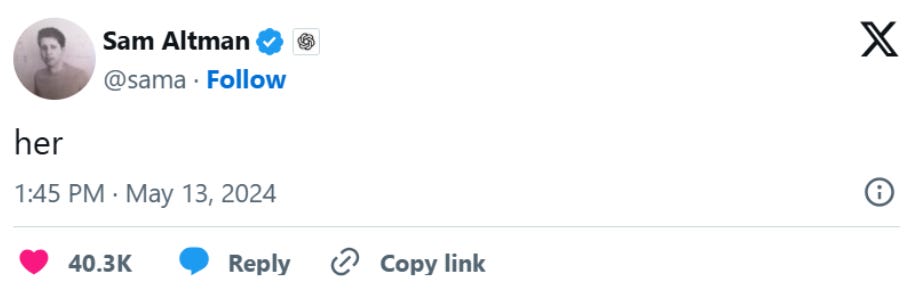
ScarJo sued OpenAI and they eventually removed the Sky voice (despite OpenAI’s protestations that it was, in fact, a complete coinkydink!).
Know this: Not all mistakes are made equal.
Sometimes, shit happens that’s outside of your control. That’s okay.
Some of the smartest people I know have deeply considered a decision and mistakes still happen. That’s okay too.
But Microsoft, Slack, and OpenAI made decisions seemingly without strategic consideration or care for how the choice would be perceived, which resulted in unforced errors that didn’t need to happen in the first place. That’s not okay.
The solution is a heavier dose of strategic communications involvement in business decisions.
Make someone responsible for brand perception
The examples from Microsoft, Slack, and OpenAI’s weren’t strictly marketing or comms mistakes. Let’s unpack this a bit, using Microsoft’s botched Recall launch as an example.
Yes, communications leads would be involved in creating messaging and positioning for a product launch like Recall and yes, marketing teams would be ready to articulate product value to customers, and do all the usual things that marketing and communications people would do.
Here’s the rub: The business decision to automatically turn on Recall for all users without sufficient privacy protections is nominally outside of the auspices of what communications/marketing would usually own during a product announcement. And while we can’t know how involved communications was in that decision, we can say a functionally savvy someone responsible for brand perception would have said something like, “Hey guys. This is a super bad idea.” Because, lo and behold, it was a super bad idea.
So who is that savvy someone responsible for brand perception? In large organizations, it can be a brand marketer (or brand marketing team), but 1) those are relatively uncommon hires and 2) they are usually not senior enough to be foundationally involved in business decisions like those surrounding the Recall launch.
The answer? Communications pros, who are trained to consider perception, need a seat at the big kids table.
The tide is turning
We’re seeing two trends across the board that indicate the elevation of communications within organizations:
According to LinkedIn, there are more than 150,000 Chief Communications Officers in the U.S. today, a number that’s on the rise.1
Axios reports that 56% of comms pros report to the CEO, with only “37% laddering up to marketing, compared to 63%” in 2023. 2
More communications pros either in the C-Suite or reporting into the CEO mean proximity to business decisions, reducing the likelihood of unforced errors like those from Microsoft, Slack, or OpenAI. And in today’s climate, protecting perception is mission-critical.
Depending on where you land on the political spectrum, both the first and second Trump terms can be categorized by either a flurry of activity or chaos. But one thing is certain, and that is that uncertainty rules the current moment. Organizations are more scrutinized than ever, and the elevation of communications in organizations is necessary given the new world order. As I wrote and Axios validates, “corporate reputation directly impacts a company's success.”
Elevate communications right now
A startup can die from reputational damage. If a brand becomes toxic or makes a massive unforced error, a startup can lose customers, revenue, and perhaps even its existence entirely. An early communications hire engaging directly with the founders, whether they be a full-time hire, part-time consultant, or challenger agency who can work intimately with a small team, is required in order to navigate a business and political climate defined by uncertainty.
Communicators often talk about the upside of storytelling, like securing press hits, having social posts go viral, or building a brand that excites and awes, because it’s fun. But playing defense — protecting a brand against self-inflicted wounds in a chaotic world — is just as important as proactive storytelling.
My advice? Don’t wait to hire a CCO or integrate communications with the founders/CEO. Do it early. Then, you’ll have a voice in the room reminding you to stop the dumb shit before it starts.
Shoutout to Emily Ann Hill for providing feedback and editing this essay. Check out Junetail Creative to see how Emily can help improve your writing and, for small businesses, develop an unforgettable brand experience.