

The unfinished Union
A love letter (and a healthy dose of criticism) for America at 250

America recently celebrated its 250th birthday.
Not everyone is feeling patriotic.1
![r/dataisbeautiful - [OC] U.S. national pride by political affiliation since 2001](https://substackcdn.com/image/fetch/$s_!Iz6O!,f_auto,q_auto:good,fl_progressive:steep/https%3A%2F%2Fsubstack-post-media.s3.amazonaws.com%2Fpublic%2Fimages%2Fb1534f79-2968-4fd1-b86a-3db49fcdcd15_2000x1626.png "r/dataisbeautiful - [OC] U.S. national pride by political affiliation since 2001")
Those whose pride has waned would point to the United States’ rank as 24th in the 2026 World Happiness Report. We’re 62nd globally in life expectancy, and our education system is lagging: We’re 28th in math, 12th in science, and 6th in reading. These are indisputable facts.
Those full of patriotic fervor would argue that our economic might is still peerless and opportunities are present here that exist nowhere else in the world — it’s why so many people from around the world want to live in America. And our military might has led to a global, free market, which has created prosperity across the world. The United States remains the world’s largest economy by nominal GDP, and GDP per capita is among the best in the world. These, too, are indisputable facts.
Why (I think) America is the greatest country on Earth
The United States Constitution is the oldest continuously operating written national constitution still in force anywhere in the world. The promise of the American experiment — a land where all people, regardless of race, creed, religion, or socioeconomic status are equal — is intact.
For me, America is an ideal we continually strive to reach. Progress, while falling short, does not mean failure. Growth should be celebrated. Acknowledging America’s shortcomings is not anti-patriotic; it’s an understanding that we’re not done with the work, and that we the people are not done forming a more perfect union.
Too often, and to our national detriment, these concepts are viewed as mutually exclusive. One must either be critical of America (and therefore be not proud of it) or one must be unabashedly supportive (unwilling to acknowledge any shortcomings).
It’s a false binary.
To wit:
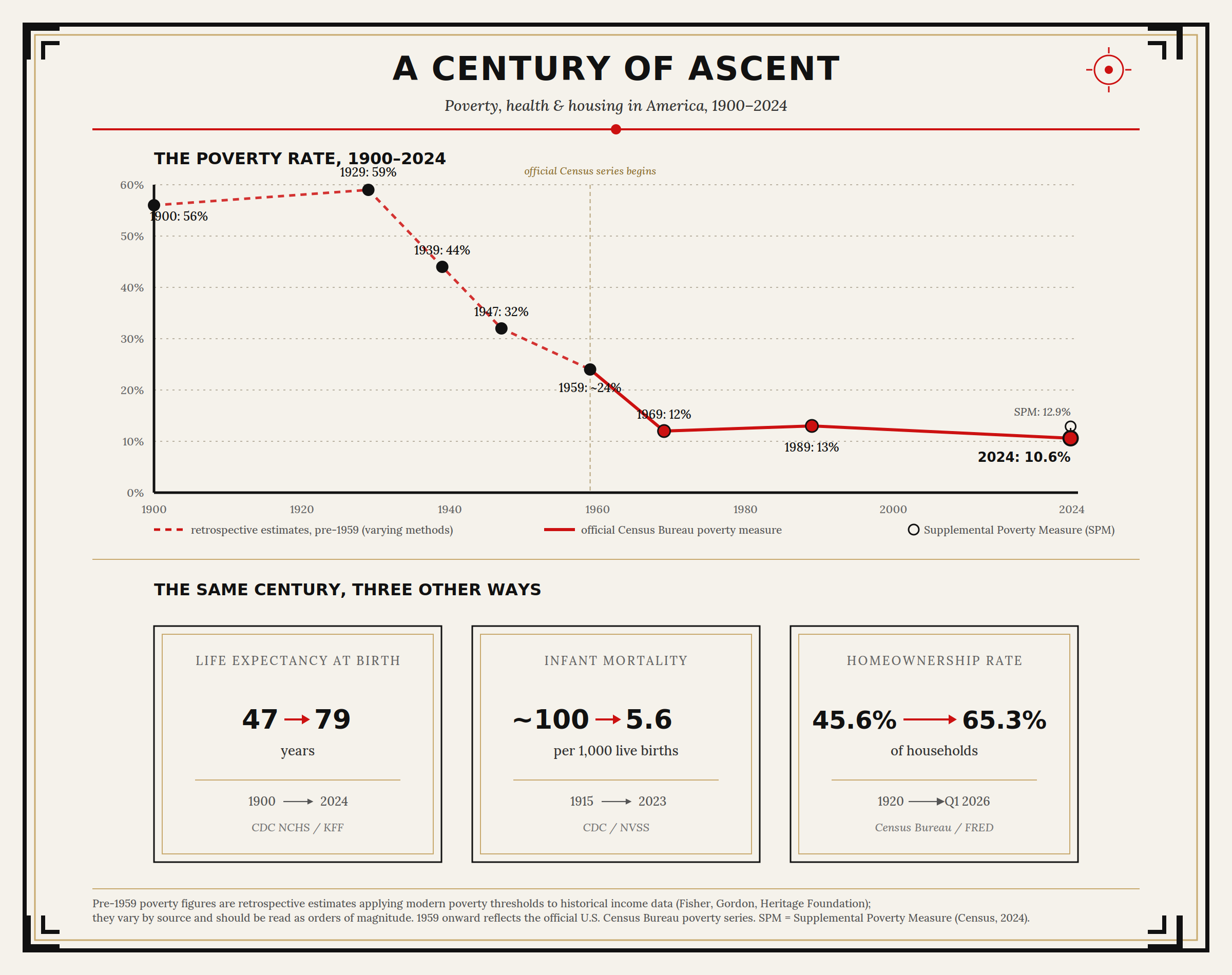
Over the last 100 years we’ve collapsed our national poverty rate. But we should still want to help people who are experiencing poverty. The number of people who own homes has drastically increased, yet housing costs are still exploding relative to income, putting home ownership out of reach for too many people (a problem that, if solved, would dramatically alter prosperity for many).
The graphic above proves America is a nation of conflicting truths, but truths nonetheless. In that vein, here are four conflicting truths I love about America.
The judicial system
The presumption of innocence and the requirement that the state carry the burden of proof is one of the most brilliant facets of American life. Our founders designed a judicial system biased towards letting a guilty person walk free — rather than send an innocent person to jail.
Even among modern judicial systems that presume innocence, American judicial fabric is special.
The burden of proof on the state in America is uncommonly high — “beyond a reasonable doubt.” Few other democracies require the state to clear such a high bar.
Jury trials by groups of peers are common in the U.S. It’s not so in other western democracies.
The inquisitorial tradition of most of continental Europe, where an investigating judge actively builds the factual record pre-trial, is markedly different from what happens in America, where the state must present evidence to a jury in public.
In the United States, illegally obtained evidence is inadmissible. Other countries have looser approaches to tainted evidence using discretionary balancing tests. The question about whether or not tainted evidence can be included in a trial is in the hands of the judge.
America also has the dubious distinction of the highest incarceration rates in the world. The majority of people who are released from prison relapse; the American judicial system’s ability to rehabilitate the guilty is left severely wanting.
For all its failings, our judicial system’s total bias towards the accused is real, rare, worth being proud of.
Free speech
It’s incredible that anyone in this country can burn an American flag without reprisal. No democracy on Earth protects speech as fiercely as the First Amendment does. Canada, the UK, Germany, France, Australia — they’ve all criminalized hate speech.
In America, you can march as a Klansman.2
You can protest a soldier’s funeral with hateful signs.3
For the most part, you can lie about people with impunity.4
America has enshrined the idea that the danger of a government empowered to define what acceptable speech is is far more dangerous than the risks of the speech itself. But free speech absolutism also allows disinformation, coordinated harassment, or hatred that doesn’t quiiiiite reach the legal limits of a threat to run rampant. We protect those who engage in hateful speech or expression more than any country on Earth — the downsides are apparent and obvious every day (just spend a little time in the comment section of any website).
But the rights enshrined in the First Amendment, including free speech, are radical — radical enough to be genuinely special.
Wealth creation
Consider this:

America is undoubtedly peerless at creating wealth. Measured at every decile of the income distribution, Americans at the bottom outpace their counterparts in France and the United Kingdom, and run approximately even with Germany. Even Mississippi — the lowest-income state in the union — exceeds the median disposable income of the United Kingdom and Japan.
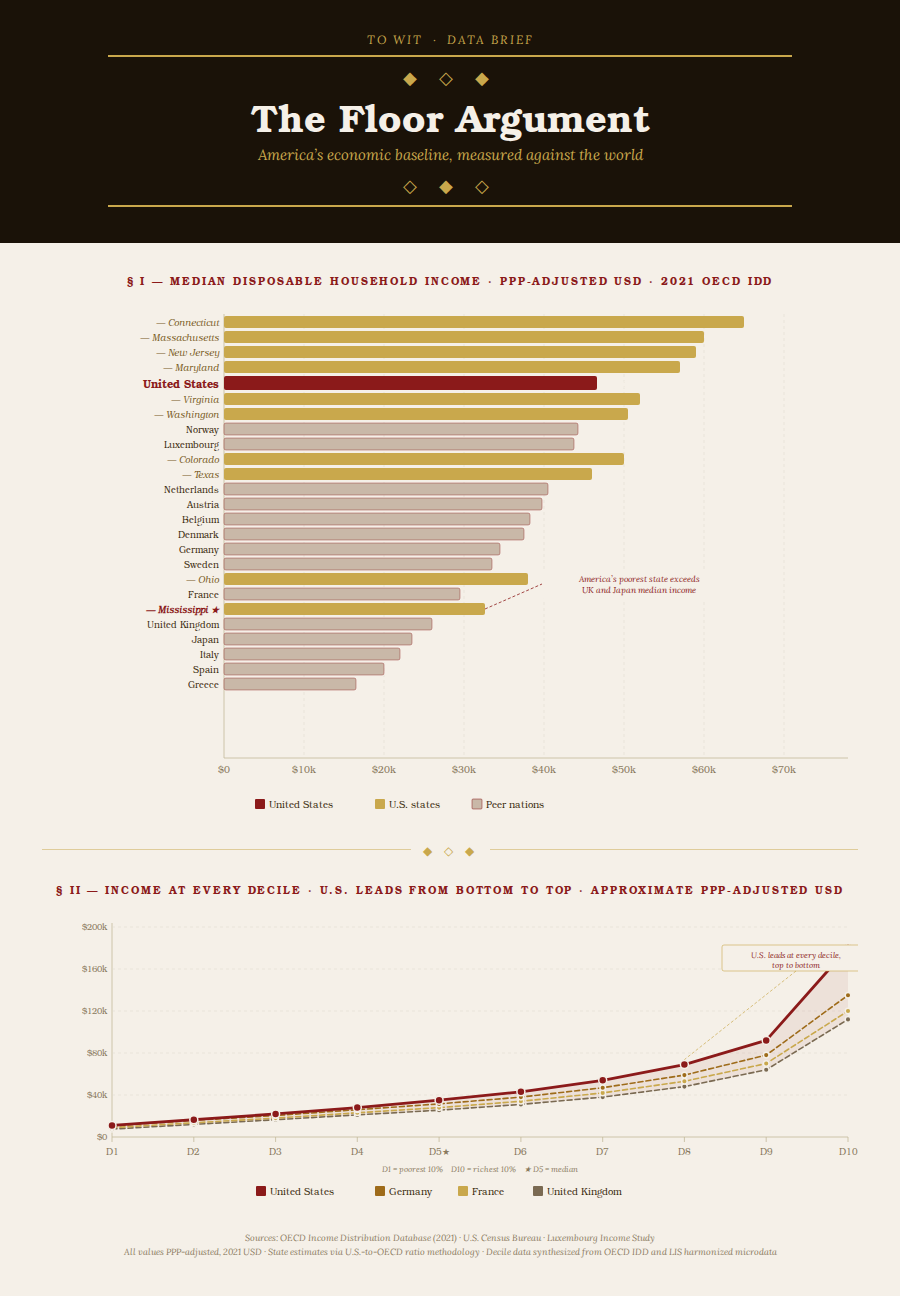
The average American in the bottom income quintile also spends about 20% of household income on healthcare, a rate far higher than peer nations (which eats into disposable income). And Miles Corak’s intergenerational earnings elasticity (IGE) data shows that Americans have less upward mobility than Germans and Nordics. That’s a problem we have to solve — and we can acknowledge the need for an economic policy that drives more upward mobility with the knowledge that Americans are, generally, a rich and prosperous people.
Immigration
“You can go to live in France, but you cannot become a Frenchman. You can go to live in Germany or Turkey or Japan, but you cannot become a German, a Turk, or a Japanese. But anyone, from any corner of the Earth, can come to live in America and become an American.” — Frmr. President Ronald Reagan
The United States is a melting pot like nowhere else in the world, and we’re better for it: The PISA gap5 between immigrant- and native-born kids in America is a few points. In France, it’s more than forty. By and large, by the second generation, immigrants’ kids are just, simply, American. Nearly 50% of Fortune 500 companies in 2025 were founded by immigrants or the children of immigrants. The Congressional Budget Office recently found6 that immigrants will add $7 trillion to the economy by 2034.
The legal immigration process is also a mess.
The caps that govern legal immigration today are decades old and haven’t been updated for modern population growth, economic change, or labor demand — in large part because Congress hasn’t passed a comprehensive overhaul of the legal immigration system since 1986. The H-1B program — the main channel for skilled foreign workers — caps new visas at 85,000 a year and allocates them by random lottery (which is dumb and bad).
We assimilate immigrants better than anyone else on Earth and our multi-national society is part of what makes America America. It’s special. Yet somehow, we cannot, for the life of us, create a salient framework where a legal, skilled, fully-compliant applicant doesn’t have to wait a decade7 to gain permanent status.
America the beautiful
250 years into the American experiment, and I could not be more proud of the ideals our country stands for — even when we haven’t reached those ideals.
You may disagree, dear reader. You may have felt yourself feeling less than patriotic as our nation celebrated its 250th. That’s okay. My hope is that collectively, we can come together. America is more than a single politician, more than one failing, more than one statistic.
We live here. We should want to make it better. We should strive to improve and reach towards the American ideal. And we should want to be proud of it.
I am.
In service of a more perfect Union — always.
Shoutout to Emily Ann Hill for providing feedback and editing this essay. Check out her website to see how Emily can help improve your writing and, for small businesses, develop an unforgettable brand experience.
In 2001, per Axios, 87% of Americans said they were extremely or very proud of our country. National pride has since cratered.
You shouldn’t.
You shouldn’t.
The legal bar for defamation is quite high.
The PISA score “measures the scholastic performance of 15-year-old students globally in reading, mathematics, and science.”
If they’re lucky!
Now on the other side of the pond, I can report that the US still has an enormous amount of goodwill in Europe. People look at me crazy for having left NYC, or talk about their dream USA road trip, wearing Americana letter jackets and cowboy boots without irony, listening almost exclusively to American music.
But I can also see sharply the disadvantages of the rah rah capitalist American economy. Sure, people have less income, even in high income NL, but there is less to save for--healthcare, pensions, and education are all free or near-free. There's less a sense that you have to be earning, competing, and striving every second. The trains, bike lanes, and airport run immaculately. People are remarkably more relaxed, and way less glued to their phones. I think its fair to say the winner take all mindset in the US has eroded the public commons and public decency.
I also get the sense that the EU economic model is highly exposed to emerging market competition, demographic drift and AI disruption with no backup plan...