


Dear reader, a quick note from me: It’s been a while since I’ve published because some important personal life events took precedent. I’m back now, and if you think anyone would enjoy The Praxis Forum, please forward this to a friend.
Now, onto Vibe Communications.
Vibe Coding, a phrase coined by Andrej Karpathy (former Director of AI and Autopilot Vision at Tesla) has been hot for a few months now. Here's a good explainer:
Vibe Coding is a prompt-driven approach to software development where you write software by describing what you want in natural language, and let AI generate the code.
Now, if you can communicate in plain English, you can ostensibly code the app of your dreams. Click-clack away on your keyboard, tell an AI what you want to build, ask it to generate code step-by-step, and with minimal effort, you are now a coder. With easily accessible tools like Claude and Cursor, you don’t need to spend time manually writing code, let alone build up years of the technical acumen that most senior developers have.
Mehul Gupta, a Data Scientist at DBS Bank, had this to say of Vibe Coding:
Vibe Coding works when you’re just testing an idea. Need a quick prototype? Perfect.
But, but, but: Want to build a production-level app via Vibe Coding? Gupta1 has a one word answer: “Oof.” The internet is rife with Vibe Coding gone awry, like this poor Twitter user who, in the period of 48 hours, swung from pure elation to the crushing reality of fucking around and finding out:
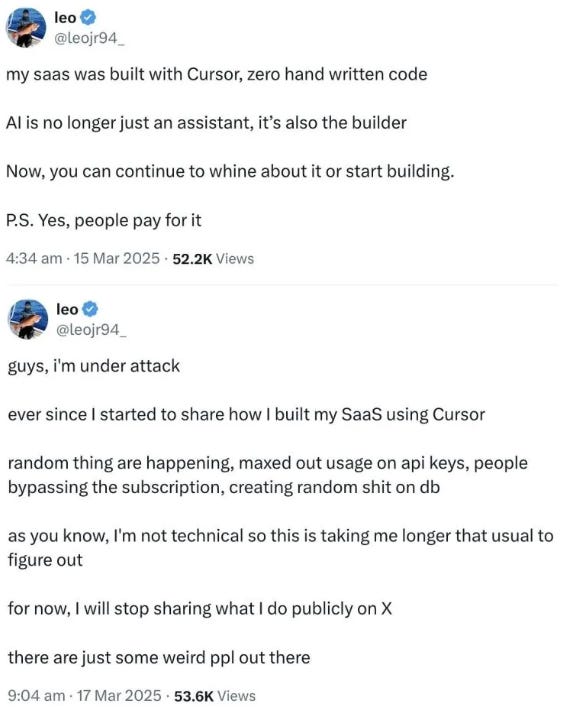
To wit:

Vibe Coding is a good way to start a project or test an idea, but when that idea matures and is ready to be deployed to real world users for mass consumption, Vibe-coded projects lack structure, aren’t properly optimized for production-level use, and are likely rife with security concerns.
For communications and PR pros, Vibe Coding’s benefits — as well as its structural breaking points — provide a roadmap for starting and growing a corporate communications program.
Vibe Communications: Good for startups
Early stage startups with no extant communications program can run into a trap: Thinking too hard. Much like a technology product evolves with feedback from its users, a communications program startups need feedback — which stories resonate with media and key audiences while serving overall communications goals — in order to add structure and rigor to a communications program.
Maybe it’s technical storytelling, showing how new technology was built through the lens of its engineers and technical leadership. Maybe it’s leveraging partners in cities across the country for hyper-local media engagement. Maybe it’s compelling thought leadership about the state of the industry. Maybe it’s all of them, or maybe it’s none. In lieu of feedback, there is no way to know what works.
Enter Vibe Communications.
The first time communicating externally programmatically can be scary for founders — they want all t’s crossed and i’s dotted, everything just so.
Then you end up here:
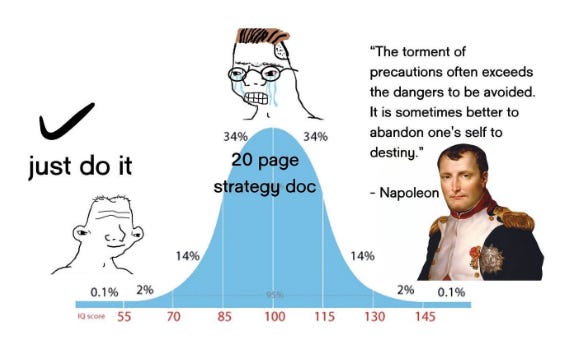
When a communications program is first starting at an early stage startup, it’s not efficient or operationally viable to apply the level of data-driven rigor that’s found in more mature enterprises because the feedback from users — media and key audiences — does not exist yet.
Vibe Communications, like Vibe Coding, can help get a communications program off the ground. It’s a comms program without a ton of rigor, structure, rules,consideration for edge cases or mass consumption. Instead, it’s optimized for speed and learning.
Here’s a four step playbook to execute Vibe Communications:
Step one: Build messaging
Messaging is the foundation of communication. Start by building a Minimum Viable Messaging framework, the communications equivalent of a minimum viable product. The first messaging framework doesn’t need to be perfect — like external communications strategies and tactics, company messaging will and should evolve as you collect and ensure that your company positions itself inline with its core audiences. Get the basics down:
A three sentence summary of the startup
Key differentiators
How the technology works
Who it’s meant to serve
How it helps those audience(s)
Step two: Lock in “key media”
As part of building messaging, you should have a rough idea of the audiences that matter. The next step is to lock in the newsletters, the podcasts, the influencers, the vertical media outlets, the traditional online news outlets, the who-or-whatevers (heretofore referred to as “key media”) that help you reach key audiences. If your audience is the Department of Defense, you should care about DefenseScoop and Tectonic and the Crossing the Valley podcast. If your audience is the general population, you might think about NPR. If you care about the freight and logistics community, Freightwaves and Supply Chain Dive are critical. Whatever your industry, whoever your audience, find your key media outlets.
Step three: Tell (good) stories
Unless you have real news, spend time telling valuable stories to key media members that will be of genuine value and interest to their readers/listeners (remember, their audience is your audience too!). For 99% of startups, no key media member cares about a product pitch. “Hey, talk to this expert” pitches can work, but they aren’t the foundation of a media outreach strategy. The point, beyond efficacy, is to begin collecting feedback to more meaningfully understand what stories resonate and what stories don’t. That starts with good storytelling.
Step four: See what sticks
Yep — see what sticks. What stories do land? What coverage do you secure? What are podcasters and Substackers expressing interest in? What stories get no interest at all? Programmatically collate this feedback and optimize towards, quite obviously, the things that are working.
The reality is some pitches and stories will land and some won’t. Remember the wise word from ayahuasca enthusiast and NFL quarterback Aaron Rodgers: R-E-L-A-X. Diligence pays dividends.
Growing beyond Vibe Communications
Like Vibe Coding, Vibe Communications will eventually cause problems. As a company grows, and as its market and brand solidifies, more intentionality — and discretion — will become necessary.
The larger enterprises that have reached this stage tend to fall into two communications buckets:
The first is focused on press releases, navel-gazing pitches, and product announcements — it’s the traditional approach: largely ineffective, and lacking in creativity.
The second bucket keeps the ethos of Vibe Communications — experimentation, learning, and quality storytelling with an aggressive focus on key audiences — but just with more rigor, structure, and formality.
Companies in bucket one end up with a glut of product and contract and other crappy announcements on their website, but to most people outside the company, it’s a meaningless series of motions. The companies in the second bucket win because they tend to index towards fewer, higher value opportunities. They hone and sharpen key messaging, explore emergent and creative opportunities to tell stories. They leverage a diverse group of charismatic spokespeople in creative ways. They build a recognizable brand.
Zipline, the world’s largest commercial autonomous delivery company, is executing at a higher level than most companies on the planet. They recently invited MKBHD to do a deep dive on their technology, they worked with Tim Stevens to do a profile on the company’s home delivery platform, and they saw co-founder Ryan Oksenhorn have an amazing Twitter thread go viral. Taken together, these three examples show how a larger, more mature company need not dive headfirst into stodgy, outmoded communications strategies.
Zipline isn’t churning out rote press releases every single week or focused on exclusively talking about what their new product is. Instead, they’re always experimenting, ideating creatively about what stories will resonate. Recently, Zipline has focused on telling stories about what autonomous drone delivery at scale means: An elderly person who can easily access their prescriptions without having to go to the pharmacy or working parents who can get a missing ingredient delivered right to their doorstep while cooking dinner. A year ago, Zipline focused on telling stories about how it built its ultra-precise home delivery system. In either case, Zipline shows how the ethos of Vibe Communications can scale in a larger organization — everything they do is so much better than just “Hey! Look! We’ve got a new drone!”
The big picture
Vibe Communications works when a communications program is starting out. I’ve done it before, and I will do it again. I also know that as organizations grow, structure and rigor become more vital to communications success.
But the best comms flacks I know never lose what makes Vibe Communications work — a communications shop optimized for speed and learning. Executing quickly, doubling down on effective storytelling, and killing darlings that aren’t working is the recipe for success.
Shoutout to Emily Ann Hill for providing feedback and editing this essay. Check out Junetail Creative to see how Emily can help improve your writing and, for small businesses, develop an unforgettable brand experience.
I'm very behind on my reading but loved this!